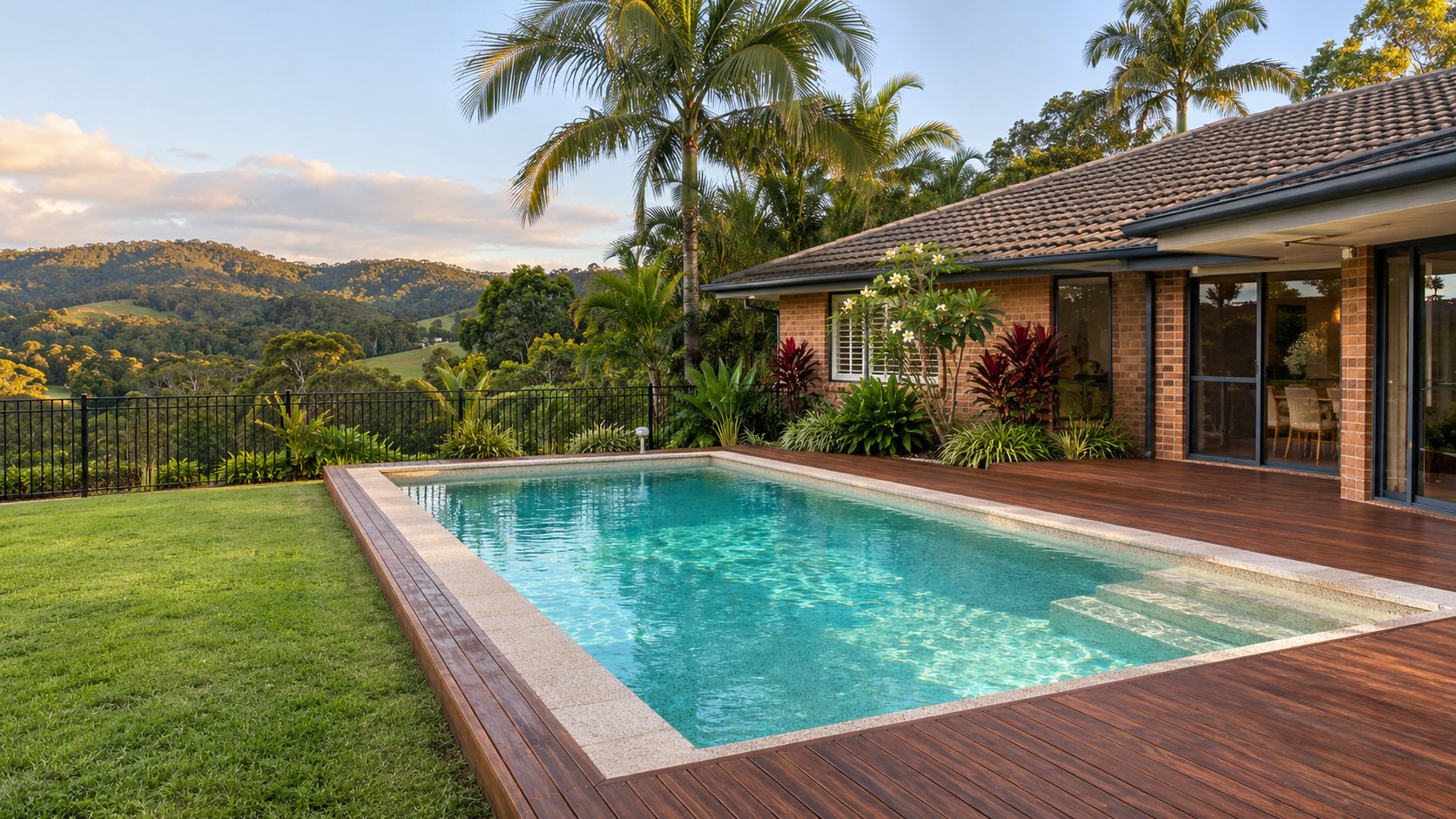
Pool resurfacing in Coffs Harbour and the Coffs Coast.
Pebblecrete, quartz, paint, tile and fibreglass pool surfaces explained, with your enquiry passed to a local pool contractor.
A rough, stained, cracked or hollow pool surface can be fixed in several ways. The finish decides the method. Here is how to tell them apart and what to ask first.
Tell us about the pool and where it is
Send the suburb, whether the pool is concrete or fibreglass, and what you are seeing: rough patches, stains that will not clean, cracks, hollow spots or lifting tiles. A photo of the whole pool and one of the worst patch is a good start. Say if the pool runs on salt water, or if the job might touch the tiles, coping or pool barrier.
Request a quote
A pool surface is a finish over a shell, and the finish decides the job.
Resurfacing means replacing or recoating the inner surface of a pool: the cement-based layer on a concrete shell, a paint or epoxy coating, the tiles, or the resin layer on fibreglass. This site connects pool owners, landlords and small accommodation businesses on the Coffs Coast with local pool contractors. We pass your enquiry on and the contractor does the work.
At the 2021 Census the Coffs Harbour local government area had 78,759 people, with 75.7 per cent of dwellings separate houses, 37.3 per cent owned outright and 29.4 per cent rented. The ABS gives no pool counts, so reading that as many backyard pools is an inference. These pages are written for house owners and landlords first.
What to settle before you book a pool resurfacing
- Pool typeConcrete, fibreglass, tiled or painted.
- Current finishPebble, quartz, plaster, paint, epoxy or tile. If unsure, send a photo and say so.
- Salt or chlorineOne chlorinated rubber data sheet says it is not suitable for salt water. Others do not mention it.
- What you are seeingRough, stained, cracked, hollow or lifting. A crack or hollow patch may run deeper than the surface.
- Size and shapeLength, width, steps and ledges, if you know them.
- What else is in the jobTiles, coping and equipment. Ask what is in the price and what is left out.
- How it is emptiedAsk Coffs Harbour City Council before the pool is emptied, and ask where the water and slurry go.
- How dust is controlledSilica controls are required when cutting or grinding concrete.
- Data sheet and start-upAsk which product, and for its data sheet and start-up instructions in writing.
- Warranty termsAsk what is covered, who gives it and what conditions apply, in writing.
- Licence or certificateAsk which one the contractor holds, then check it on the NSW licence check.
Five kinds of pool surface work, and a cost guide
Each page covers one family of finishes and what to ask. For a side-by-side view of pebblecrete, quartz, paint and tile, read the finish comparison.
Pebblecrete & quartz resurfacing
Exposed aggregate, pebblecrete and quartz finishes for concrete pools: how they differ, what resurfacing involves and what to ask a Coffs Harbour contractor.
Read more →Pool renovation & retiling
Waterline tiles, coping, steps and bundled works around a new pool surface, and how the jobs fit together on a renovation.
Read more →Replastering & render finishes
Plaster, cement render and Marblesheen-style finishes: when they are used, how they differ from aggregate or paint and why start-up care matters.
Read more →Pool painting & epoxy coatings
Chlorinated rubber, acrylic and epoxy pool coatings compared by what the data sheets say about weather, drying and fill times.
Read more →Fibreglass pool resurfacing
Recoating a fibreglass pool that has faded, chalked or bloomed, and how that differs from resurfacing a concrete shell.
Read more →What changes the cost
Size, finish, repairs, tiles, access and timing all move the price of a resurface, and a written quote should itemise each one.
Read more →Across the Coffs Coast, from Sawtell to Moonee Beach
Each area page has local housing facts and points to the council.
Coffs Harbour suburb page · Sawtell and Boambee · Toormina and Boambee East · Woolgoolga · Korora and Moonee Beach
From enquiry to written quote
We pass it on
It goes to a local pool contractor. We do not quote or do the work.
The contractor follows up
Expect questions about salt, what you are seeing, access and timing.
Compare written quotes
NSW Government advice is to get more than one. Compare the lines below.
Check before you sign
Check the licence category and expiry. Do not pay any money without a written contract, says the NSW Government.
Plan the emptying and start-up
Ask the council where the water goes, and get the start-up instructions in writing.
Two rules that matter before you sign
NSW Government pages list pool surfacing and surface coatings inside the swimming pool repairs and servicing category and say a licence or certificate is needed for that category. Check the contractor's licence category and expiry on the NSW licence check and ask Building Commission NSW on 13 27 00 if you are unsure. The pages do not map each finish to a category, so this site does not either.
The Coffs Harbour City Council page covers new pools and the NSW Swimming Pool Register, not renovating an existing pool. Pool water, backwash and slurry should not go to the stormwater drain. Ask the council before the pool is emptied. Silica controls are required when cutting or grinding concrete, per SafeWork NSW.
Licence, contract and warranty in NSW · Draining, dust and pool barrier rules
What this site cannot do
This site cannot resurface a pool, quote a price, sign a contract or inspect your pool. It cannot tell you which licence or certificate a particular job needs, because the NSW pages do not say, and it cannot say whether Coffs Harbour City Council requires anything for resurfacing an existing pool, because the council page found does not address it. It cannot see your pool, so it cannot say what finish you have or whether it needs work. Ask the contractor, the council and Building Commission NSW.
Check the current rules before you rely on this
This page describes the NSW licence wording for pool surfacing, the Coffs Harbour City Council pool page and silica controls. It describes the rules in general terms as they stood in November 2026. Standards, forms, thresholds and fines change.
The authoritative sources are NSW Government, swimming pool repairs and servicing work (licence page), NSW Government, checking your contractor or tradesperson is qualified, NSW Government, building contracts and home building compensation, Coffs Harbour City Council, swimming pool approval and safety requirements and SafeWork NSW, work safely with crystalline silica and engineered stone. Where anything here differs from those sources, they are right and we are not.
We are not pool contractors, builders, regulators or lawyers. For what applies to your job, ask the contractor which licence or certificate they hold and check it on the NSW licence check, then ask Building Commission NSW (13 27 00). Ask Coffs Harbour City Council about emptying the pool, registration and the pool barrier, and SafeWork NSW about dust and chemicals.
Accurate at the time of writing, November 2026. Always check the source before relying on it.
What a pool resurfacing quote should itemise
This site does not publish prices, because one figure would be wrong for most pools. Make each quote spell out the same things. The cost guide explains what moves the number.
| Line | What to ask |
|---|---|
| Scope and area | Which surfaces, and the area covered. |
| Old finish removal | How the old finish comes off. |
| Finish and product | The product named, with its data sheet. |
| Hollow areas | How drummy patches are found and repaired. |
| Cracks and leaks | Whether they are checked, and what repair is included. |
| Tiles and coping | In or out of the price. |
| Steps and ledges | Whether they are priced separately. |
| Plumbing and equipment | In or out of the price. |
| Emptying and disposal | Where the water and slurry go. |
| Dust control | The method used when grinding or cutting. |
| Access | Gates, slopes and where equipment stands. |
| Timing and start-up | Start date, duration and written start-up instructions. |
| Warranty | Terms in writing, and who gives them. |
| Licence or certificate | Which one is held, checked on the NSW licence check. |
| Payment | Schedule and any deposit, in the written contract. |
More answers in full: how long resurfacing takes · signs a pool needs resurfacing · which finish to choose
Things Coffs Coast pool owners ask
How much does it cost to resurface a pool in Coffs Harbour?
It depends on the pool and the job, so this site does not quote a figure. The main drivers are pool size and shape, the existing surface and whether it has to be removed, the finish chosen, hollow or cracked areas found once the old surface is off, tiles and coping, steps and ledges, plumbing and equipment, access and timing. Get more than one written quote and compare what each includes. The cost guide goes through each driver.
How long does pool resurfacing take?
It depends on the finish and the stages involved: emptying, preparing the surface, repairs, applying the finish, curing, refilling and starting up. Published timelines disagree, and a product data sheet may set a minimum dry time before filling that is longer in winter than in summer. Ask the contractor for a timeline for your pool and finish, and for the start-up instructions in writing. The timing guide explains each stage.
How often should a pool be resurfaced?
Ranges published by makers and trade publishers differ widely, from a few years to a couple of decades, and depend on water chemistry, how the pool is used and the quality of the installation. This site does not give a number. Signs such as rough patches, stains that will not clean, cracks or hollow spots matter more than a calendar. Ask for the product data sheet and the written warranty terms.
What are the signs my pool needs resurfacing?
Common signs include a rough or chalky surface, stains that will not clean, visible wear, cracks, exposed material underneath, hollow or drummy patches, loose pebbles, blisters, and tiles that lift or fall. These come from consumer and trade articles, not standards. A crack or hollow area can mean more than a surface problem, so ask for it to be assessed. The signs guide goes through each one.
Pebblecrete, quartz or paint: which is better?
Sources describe them differently and none can say which is better for your pool. Pebblecrete and quartz are cement finishes with exposed aggregate, paint and epoxy are coatings with product-specific limits, and tile is called a premium finish by one publisher. Published lifespans overlap and disagree. The better questions are what your shell needs, whether you use salt, and who gives the warranty. The comparison guide sets them out.
Can a pool be resurfaced in winter?
Possibly, but only within the product's limits on the day. Data sheets set minimum application temperatures, rain-free periods and dry times before filling, and these differ by product. Some set a minimum of 10 C or higher. Published advice on the best season conflicts. Ask the contractor which product will be used, what its data sheet allows and what happens if the weather turns. The timing guide discusses this.
How soon can I swim after my pool is resurfaced?
Follow the written start-up instructions for the product used. Instructions differ by product and system, and this site has not found Australian maker figures for a swim date, so it does not give one. Warranties often depend on following the start-up instructions, so ask for them in writing before work starts. The process and start-up guide explains the stages and what to ask.
Does pool resurfacing need a licence or certificate in NSW?
NSW Government pages list pool surfacing and surface coatings inside the swimming pool repairs and servicing category and say a licence or certificate is needed for that category. They do not say which category each finish or mixed job needs. Check the contractor's licence category and expiry on the NSW licence check, and ask Building Commission NSW on 13 27 00 if you are unsure. The licence guide sets out the detail.
Send a photo of the pool and a suburb
The suburb, the pool type, the current finish and a photo of the pool. That is usually enough to start.