Signs your pool needs resurfacing: what you can see
The signs your pool needs resurfacing are usually ones you can feel or see: a surface that has turned rough or chalky, stains that come back, cracks, hollow-sounding patches, loose pebbles, blisters and tiles that are lifting. The list below comes from consumer and trade publishers and a coatings maker. They are publisher statements, not standards, and one sign on its own rarely settles the question. A sign tells you to ask for an assessment. It does not tell you which finish or repair is needed.
We are a referral service. We pass your enquiry to a local contractor, who looks at the pool. This page is about what to notice before that visit. The failure guide covers why these things happen.
Sign by sign: what it can mean and what to do
| Sign | What it can mean | What to do |
|---|---|---|
| Rough, chalky or uncomfortable underfoot | The finish may be wearing. One chlorinated rubber sheet calls chalking part of the coating's designed erosion. | Note where it is worst, and ask whether it is wear or a chemistry problem |
| Stains that come back | A coatings maker lists black and rust staining among common ageing signs. It says rust coming from below can point to corrosion in the pool's structural steel. | Photograph the stain, try cleaning, then ask for an assessment if it returns |
| Visible wear or exposed material | Worn areas and exposed underlying material are listed by a consumer guide as signs of an ongoing surface problem. | Photograph the area and note whether it is spreading |
| Cracks | One consumer publisher says larger cracks may indicate structural movement. A crack can also mean more than a surface problem and can signal a leak. | Measure it, photograph it and note whether the pool loses water |
| Hollow or drummy patches | The finish may have come away from the shell. One epoxy guide tells the applicator to tap the surface with a notched hammer to find soft, crumbly or drummy areas. | Mark the patch and ask for it to be sounded and assessed |
| Calcium build-up | Trade sources list mineral deposits among the signs of an ageing surface. | Ask whether it is a surface problem or a chemistry one |
| Sharp or loose pebbles | A coatings maker lists sharp or loose pebbles that cut feet or clog filters among common ageing signs. | See the section below on loose pebbles |
| Blisters and discolouration | A trade magazine lists these among the signs. Water can get under a finish as it deteriorates. | Photograph and ask for an assessment |
| Damaged or falling tiles | The same magazine lists these. Waterline tile problems are often handled alongside a new surface. | See the renovation and retiling page |
| Water chemistry hard to keep in balance | A consumer guide lists difficulty keeping chemistry stable despite proper treatment as a sign. | Tell the contractor what you have been doing and for how long |
A crack or a hollow patch can mean more than a surface problem
This is the point the sources return to. A surface coating covers the shell. It does not repair it. One chlorinated rubber data sheet says structural cracks over 3 mm and leaks need professional assistance (chlorinated rubber data sheet). A trade magazine says pool paints are non-structural and unsuitable for cracked or leaking pools (trade magazine article). If you can see a crack that is wider than a hairline, a patch that sounds hollow or a wall that stays wet, ask for it to be assessed before you ask about finishes. The contractor decides what is cosmetic and what is structural.
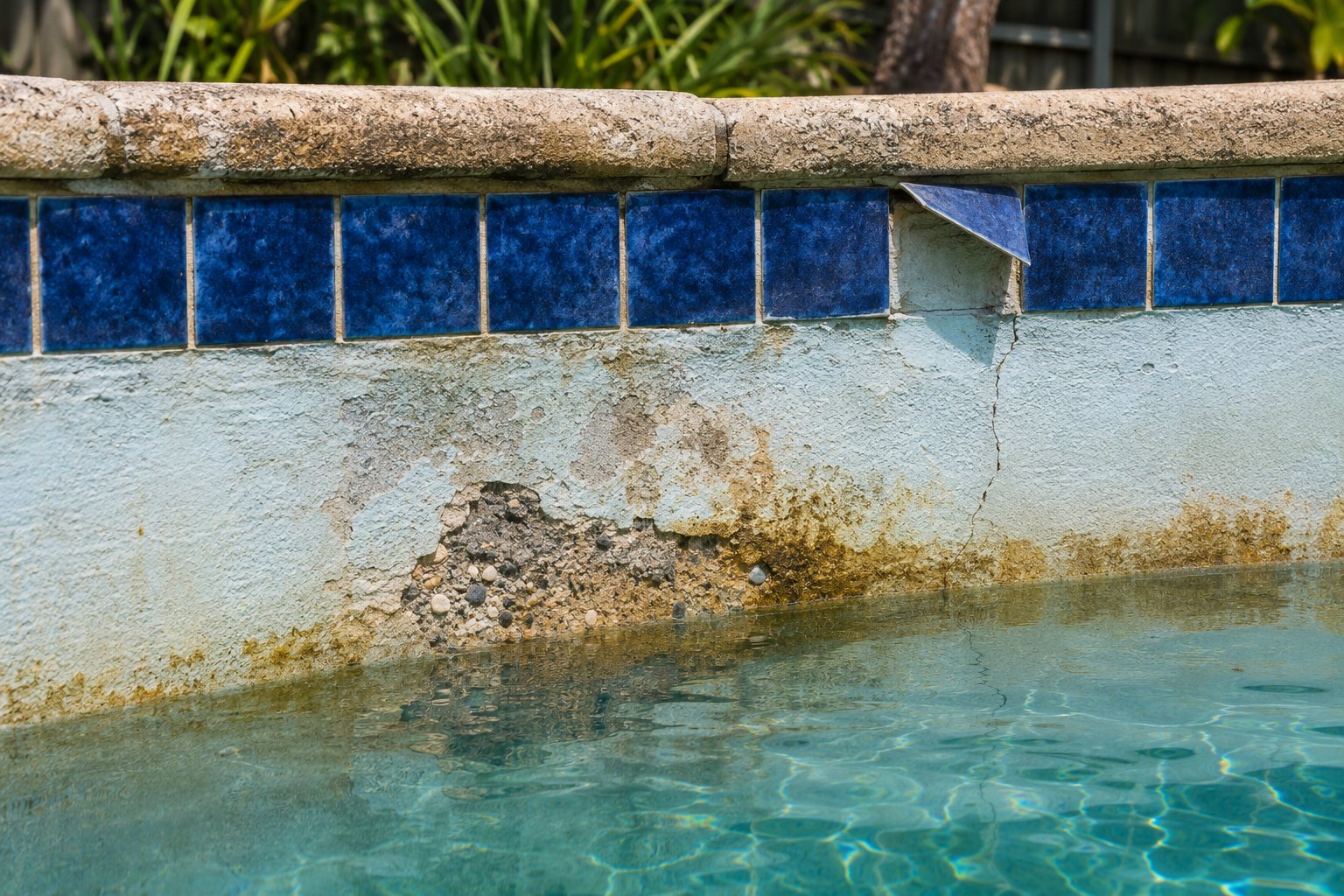
Staining: try cleaning first?
For stains, one pool-service blog from the US suggests trying an acid wash before resurfacing. That is one US business's advice, not an Australian standard, and we do not recommend or generalise from it. We give no acid ratios, because they are product-specific. NSW Government pages list acid washing and pool cleaning inside the swimming pool repairs and servicing category (NSW swimming pool repairs and servicing page), so ask who would do it and which licence or certificate they hold. If the stain returns after cleaning, or sits over a rough or hollow patch, the surface may be the cause.
Loose pebbles: curing or a warning?
One manufacturer's page, whose origin is not stated, says loose pebbles during the initial curing period are normal, and that larger amounts later can point to unbalanced chemistry weakening the cement (manufacturer's page). So the timing matters. A few stray pebbles in a new pebblecrete surface may be part of settling in. Pebbles that keep coming loose years later, or that cut feet and clog the filter, are a sign to ask about. A coatings maker lists them among common ageing signs (coatings maker's article).
How often should a pool be resurfaced?
Ranges published by makers and trade publishers differ widely, from a few years to a couple of decades, and depend on water chemistry, use and installation quality. We give no number. A magazine, a manufacturer's marketing page and a council news item describe different products and different jobs, and none is a test of your pool (one trade magazine on pool surfaces gives its own view). The better questions are: what is the surface made of, what do the signs above show, and what do the data sheet and the written warranty terms say? Ask who gives the warranty and what it depends on.
When to get the pool assessed
Get an assessment when a sign is spreading, when a patch sounds hollow, when the pool loses water, or when stains and roughness are making the pool unpleasant to use. Match the sign to the page that explains the work:
- Roughness or ageing on a pebble or quartz finish: pebblecrete and quartz resurfacing.
- Tired or lifting tiles and coping: renovation and retiling.
- Rough, chalky or stained plaster: replastering and render finishes.
- Peeling or chalking paint: painting and epoxy coatings.
- Faded or blooming fibreglass: fibreglass resurfacing.
The process guide shows what happens next. NSW Government pages list pool surfacing and surface coatings inside the swimming pool repairs and servicing category and say a licence or certificate is needed for that category. Check the contractor's licence category and expiry on the NSW licence check, and ask Building Commission NSW on 13 27 00 if you are unsure.
What a signs guide cannot do
It cannot diagnose your pool. A photo and a list of signs do not show whether a crack moves, whether a hollow patch is small or large, or whether a stain is surface deep. The sources are consumer and trade publishers and manufacturers, and they describe common signs, not a test.
Use the table to describe what you see, and send photos of the whole pool and of each problem area. The contractor taps, looks and decides whether the pool needs resurfacing, repair or neither.
Check the current rules before you rely on this
This page describes common signs of an ageing pool surface as consumer and trade publishers describe them, and does not diagnose any pool. It describes the rules in general terms as they stood in November 2026. Standards, forms, thresholds and fines change.
The authoritative sources are AccomNews, pool surface options (trade magazine, undated), Industrysearch, pebblecrete pools and upgrading (coatings maker's article, flag: marketing), Pool and Spa Marketing, best practices for completing concrete pool interiors (trade magazine, 2017, country inferred as Canada), Luxapool, epoxy pool coating application guide for Marblesheen and Quartzon surfaces (VER1601), PebbleTec, how long a pebble pool finish lasts (manufacturer marketing, origin not stated, flag) and NSW Government, swimming pool repairs and servicing work (licence page). Where anything here differs from those sources, they are right and we are not.
We are not pool contractors, builders, regulators or lawyers. For what applies to your job, ask the contractor which licence or certificate they hold and check it on the NSW licence check, then ask Building Commission NSW (13 27 00). Ask Coffs Harbour City Council about emptying the pool, registration and the pool barrier, and SafeWork NSW about dust and chemicals.
Accurate at the time of writing, November 2026. Always check the source before relying on it.