How much does it cost to resurface a pool?
The cost of pool resurfacing depends on the pool, the finish you choose and what is found under the old surface, so this page gives no figure. A number that ignores the size, shape and condition of your pool would be a guess dressed up as a price. What the page can do is show what moves the price, in which direction, and what a written quote should spell out, so that two quotes can be compared line by line.
We are a referral service. We pass your enquiry to a local contractor, who inspects the pool and sets the price. We do not quote and we do not do the work.
Why one figure is wrong for most pools
Two pools with the same surface area can need very different work. One has a sound shell and a worn surface. The other has hollow patches, a crack that moves and waterline tiles that are lifting.
A rate per square metre, wherever you meet it, tends to blend jobs like these together. One rate may include removing the old finish, new waterline tiles and coping repairs. Another may be the finish alone. Until you know what sits inside a figure, you cannot compare it with a quote for your pool.
What moves the price
Contractors usually build a price from the area, the finish, the preparation and the repairs. The table lists the factors and what to tell the contractor so the quote fits your pool.
| Factor | How it moves the price | What to tell the contractor |
|---|---|---|
| Size and shape | More area means more material and labour. Curves, steps and spas add hand work. | Length, width and depth if you know them, and a photo of the whole pool |
| The existing surface | If the old finish has to come off, the job includes removal, dust control and disposal. | What the pool has now, if you know, and whether it has been painted before |
| The new finish | Finishes are different products with different methods and skill levels. | Which finishes you are weighing up, and whether the pool is salt or chlorine |
| Hollow or lifting areas | Found by tapping once the pool is empty, then cut out and repaired. The extent is often unknown until then. | Whether you have seen drummy patches or flaking |
| Cracks and leaks | A crack can be cosmetic, or a sign of movement or a leak. Repairs come first. | Where the cracks are, whether they have grown, and whether the pool loses water |
| Tiles and coping | Often priced as separate items. Replacing them adds materials and labour. | Which tiles are loose, missing or dated, and whether the coping is cracked |
| Steps and ledges | Fine detail takes more hand work, and one epoxy data sheet calls for an extra coat on steps and ledges. | How many steps, ledges and benches the pool has |
| Plumbing and equipment | Ask whether fittings and equipment are in or out of the quote. | What equipment is fitted and what has been repaired before |
| Access | The route from the truck to the pool affects how materials and debris move. | Gate width, slope and where a truck can stand |
| Season and booking time | Data sheets set temperature and rain limits, so a start date can move (see the timing guide). | Your preferred timing, how flexible it is, and what the contract says if the date moves |
| Allowance for hidden defects | Many quotes carry an allowance for what appears once the surface is off. | Ask how the allowance is stated and what triggers it |
The factors are not equal. On a pool with a sound shell the finish may matter most. On one with failing tiles and a cracked shell, repairs may outweigh it. If two quotes differ widely, look at the table before the total.
Hidden defects: why the first number can move
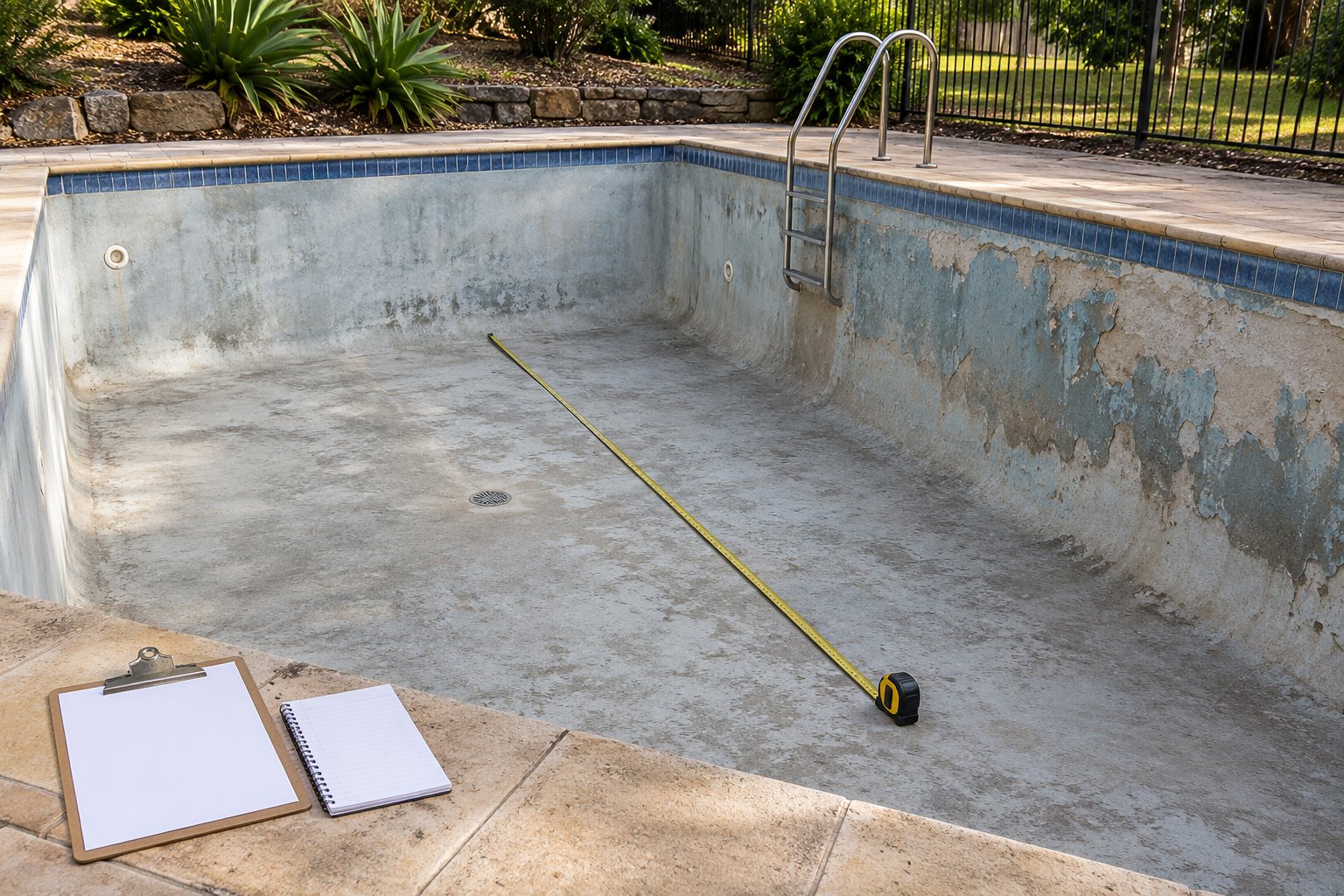
The old surface hides the shell. Once it is off, the contractor can see what is underneath. One epoxy coating guide tells the applicator to drain the pool and tap the surface with a notched hammer, and says soft, crumbly or drummy areas must be repaired before coating. The same guide says that if more than 10 per cent of the pool area is unsound, all the old finish comes off (one epoxy guide for Marblesheen and Quartzon surfaces). A trade magazine says hollow areas must be removed and deep ones filled before re-plastering (a trade magazine article on concrete pool interiors).
A fair quote says how extra repairs are priced. SPASA, an industry body and not a regulator, lists provisional sums and a variations process among the things a contract should include (SPASA contract checklist). If the work counts as residential building work, NSW Government pages say variations must be in writing and signed by both parties.
What a quote should itemise
Ask for a written quote that shows each of these separately, or says plainly that it is included or excluded.
- The scope and the area, with the old finish named if known.
- How the old surface is removed and how hollow areas are handled.
- The new finish and product, with the data sheet and written start-up instructions.
- Cracks and leak checks.
- Tiles, coping, steps, ledges, plumbing and equipment: in or out.
- How the pool is emptied and where the water and slurry go.
- How dust is controlled when the old surface is ground, chiselled or blasted.
- Access, timing and the start-up steps.
- Written warranty terms and who gives them.
- The licence or certificate the contractor holds.
- The payment schedule and any deposit.
The renovation and retiling page explains how tiles, coping and equipment fit around a new surface, and the pebblecrete and quartz page covers work on a concrete shell. The process guide lists the steps.
Contracts, deposits and the licence check: the short version
NSW Government pages say to get more than one written quote, to pay nothing without a written contract and to check the contractor's licence category and expiry on the NSW licence check. They also say a contractor licence is needed to carry out, advertise or contract for building or trade work valued at more than $5,000 in labour and materials including GST, and they list pool surfacing and surface coatings inside the swimming pool repairs and servicing category (NSW swimming pool repairs and servicing page).
If the work counts as residential building work, NSW Government pages say a written contract is needed above $5,000 including GST, and a small jobs contract for work from $5,000 to $20,000. Above $20,000 the contractor must have Home Building Compensation cover before asking for a deposit or other payment, and the maximum deposit is 10 per cent (NSW building contracts page). The pages we read do not say whether pool resurfacing counts as residential building work, so ask the contractor and Building Commission NSW on 13 27 00. The licence, contract and warranty page goes through this, and the draining and dust page covers the water and dust questions.
Comparing two quotes
Check that both quotes cover the same area, removal method, finish and extras. A lower total that leaves out tiles, coping or the disposal of water and slurry is not a lower price for the same job. Where an item is missing, ask for it in writing before you decide. If a problem arises later, Building Commission NSW describes the complaints process.
What a cost guide cannot do
It cannot tell you what your pool will cost, because it does not know the size, the shell, the finish, the access or the season. It does not rank contractors, set a budget or replace a written quote from someone who has seen the pool. It lists what moves the price so you can ask better questions. Send your suburb, a photo of the whole pool and a close photo of the problem area, and the contractor decides the scope and the price.
Check the current rules before you rely on this
This page describes what moves the price of pool resurfacing and what a written quote should itemise, without giving dollar figures. It describes the rules in general terms as they stood in November 2026. Standards, forms, thresholds and fines change.
The authoritative sources are NSW Government, checking your contractor or tradesperson is qualified, NSW Government, building contracts and home building compensation, SPASA, pool and spa contracts (industry body, not a regulator), NSW Government, swimming pool repairs and servicing work (licence page) and Building Commission NSW, building defect complaints. Where anything here differs from those sources, they are right and we are not.
We are not pool contractors, builders, regulators or lawyers. For what applies to your job, ask the contractor which licence or certificate they hold and check it on the NSW licence check, then ask Building Commission NSW (13 27 00). Ask Coffs Harbour City Council about emptying the pool, registration and the pool barrier, and SafeWork NSW about dust and chemicals.
Accurate at the time of writing, November 2026. Always check the source before relying on it.